


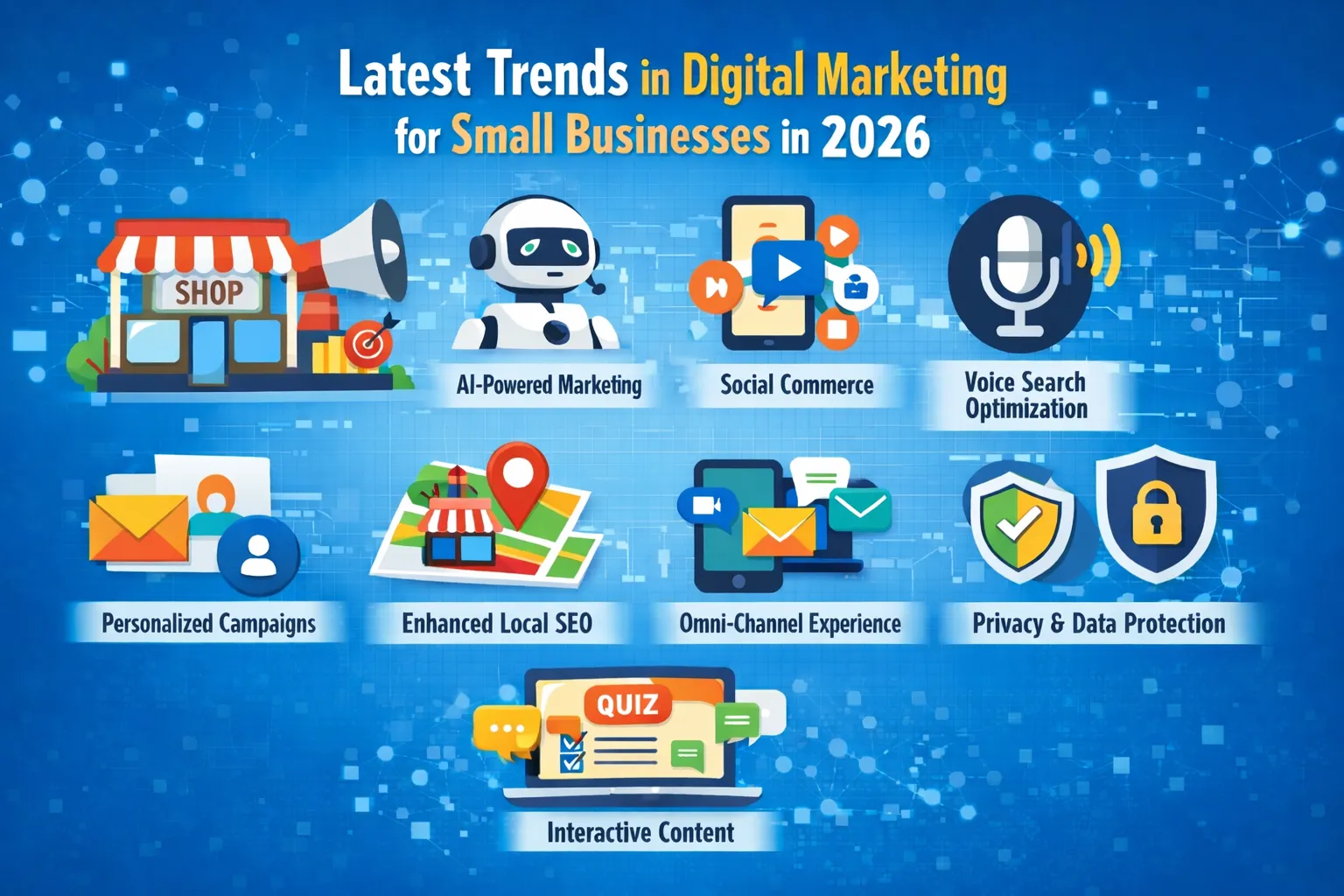
Digital marketing in 2026 is no longer just about “being online.” It’s about being visible, relevant, and trusted in a world dominated by AI-driven search, personalized experiences, and rich search results. For small businesses, adapting to the latest trends is not optional — it’s the difference between steady growth and digital invisibility.
The Digital Marketing Shift in 2026
Search results don’t look the same anymore.
Instead of simple blue links, Google now displays:
-
Star ratings
-
Product pricing
-
Stock availability
-
FAQs
-
Local business highlights
If your competitors show up with rich, enhanced listings while your business appears as plain text, who do you think gets the click?
In 2026, digital marketing is defined by:
-
AI-powered personalization
-
Voice and visual search growth
-
Short-form video dominance
-
Conversational commerce
-
Structured search experiences
Small businesses that adapt to these shifts are gaining higher visibility, better engagement, and stronger conversions.
If you want a strong foundation before implementing advanced tactics, explore our guide on SEO Optimization for Small Businesses to understand how search visibility works today.
Understanding Schema Markup and Why It Matters
One of the most powerful — yet underutilized — tools in 2026 is schema markup (structured data).
Schema markup is a type of code added to your website that helps search engines understand your content clearly and contextually.
Think of it this way:
Without schema → Search engines “guess” what your page is about.
With schema → You directly tell them.
This simple difference changes everything.
What Schema Markup Does
Schema enables search engines to display rich results, such as:
-
Product ratings
-
Price information
-
Availability status
-
Event dates
-
Business details
-
FAQs and how-to steps
These enhanced listings improve click-through rates because they:
-
Stand out visually
-
Provide instant credibility
-
Deliver useful information upfront
-
Reduce user hesitation
For ecommerce businesses, schema is especially powerful because it allows product details to appear directly in search results.
To understand how this fits into the broader marketing ecosystem, read our article on Digital Marketing Trends Every Small Business Should Know.
How Schema Increases SEO and Ecommerce Visibility
Let’s move from understanding to impact.
Why should a small business invest time in structured data?
Because schema directly influences:
1. Higher Click-Through Rates (CTR)
Rich snippets attract attention. When customers see:
-
A 4.7-star rating
-
“In Stock” availability
-
Competitive pricing
They’re far more likely to click your result.
2. Better Ecommerce Conversions
Schema reduces friction. Customers know what to expect before clicking. This pre-qualified traffic often converts better.
3. Voice Search Optimization
Voice assistants rely heavily on structured content. Schema increases the chances of your content being selected as a spoken answer.
4. AI and Machine Learning Compatibility
Search engines in 2026 are heavily AI-driven. Structured data provides clean signals that help algorithms understand intent and relevance.
5. Competitive Advantage
Many small businesses still ignore schema. Implementing it properly gives you an immediate edge.
If you're planning to scale your online store this year, don’t miss our breakdown of Ecommerce Trends Shaping 2026.
How to Add Schema Markup to Product Pages (Step-by-Step)
Now let’s move into practical implementation.
Step 1: Choose the Right Schema Type
For product pages, use:
-
Product
-
Offer
-
AggregateRating
-
Review
These provide search engines with complete product context.
Step 2: Use JSON-LD Format (Recommended)
Google recommends JSON-LD because it’s clean, flexible, and easy to manage.
Here’s a basic example:
{
  "@context": "https://schema.org/",
  "@type": "Product",
  "name": "Premium Leather Wallet",
  "image": [
    "https://example.com/images/wallet1.jpg"
  ],
  "description": "Handcrafted premium leather wallet with RFID protection.",
  "sku": "WAL-12345",
  "brand": {
    "@type": "Brand",
    "name": "LeatherCraft Co."
  },
  "offers": {
    "@type": "Offer",
    "url": "https://example.com/product/premium-leather-wallet",
    "priceCurrency": "USD",
    "price": "79.99",
    "availability": "https://schema.org/InStock"
  },
  "aggregateRating": {
    "@type": "AggregateRating",
    "ratingValue": "4.5",
    "reviewCount": "85"
  }
}
Step 3: Customize It for Your Business
Update:
-
Product name
-
Description
-
Images
-
Price
-
Availability
-
Reviews
Only include ratings if they genuinely exist. Accuracy is critical.
Step 4: Insert Into Your Product Page
Place the script:
-
Inside the
section
OR -
Just before the closing tag
If you use platforms like Shopify, WooCommerce, or Magento, you can add structured data via theme files or plugins.
Step 5: Test Before Publishing
Use:
-
Google Rich Results Test
-
Schema Markup Validator
Fix any warnings before going live.
Tracking Your Results: Measuring the Impact
Adding schema is only the first step. Monitoring performance ensures long-term success.
1. Google Search Console
Check the “Enhancements” section for:
-
Structured data errors
-
Rich result eligibility
-
Impressions and clicks
2. Performance Reports
Compare:
-
CTR before vs. after schema
-
Organic impressions
-
Average ranking
3. Google Analytics
Track:
-
Organic traffic growth
-
Conversion rate changes
-
Add-to-cart behavior
-
Engagement metrics
4. SERP Monitoring Tools
Tools like Ahrefs or SEMrush can track rich snippet appearances and search feature visibility.
5. A/B Testing
If possible, test schema on a portion of product pages and compare performance against control pages.
Data-driven refinement is key in 2026.
Final Thoughts: Best Practices for Small Businesses in 2026
To succeed in digital marketing this year:
✔ Embrace AI and Personalization
Tailor experiences based on user behavior and preferences.
✔ Optimize Beyond Traditional SEO
Focus on rich results, voice search, and visual discovery.
✔ Implement Schema Strategically
Start with product pages, then expand to services, blogs, FAQs, and local business markup.
✔ Monitor, Measure, Improve
Digital marketing success comes from continuous testing and optimization.
✔ Integrate Everything
Schema works best alongside strong SEO, quality content, UX improvements, and strategic digital marketing campaigns.
Conclusion
In 2026, small businesses compete on digital clarity and structured visibility — not just keywords.
Schema markup transforms how search engines understand your content. When combined with modern SEO strategies and emerging ecommerce trends, it can significantly increase traffic, engagement, and sales.
The opportunity is clear.
The tools are accessible.
The competitive advantage is waiting.
Now it’s time to implement — and turn structured search visibility into measurable business growth.